
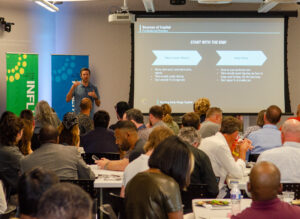
Phil Shmerling opened by telling the room to skip most of what they’d read online about pitching. That advice, he said, is written for Silicon Valley and New York. Nashville doesn’t have a name for every stage of a raise the way those cities do. There’s no local fund waiting for a “pre-seed C bridge.” Series A healthcare and Series A fintech round out the entire local venture bench.
So instead of deck slides, Phil, founder of Brook and formerly a senior VP at Studio Bank, spent the hour on where the money for a business at this stage actually comes from, then took real questions from the room: about interest rates, SAFE notes, dilution, whatever people actually needed answered. That’s the part you can’t get from a blog post. It’s a room full of founders and one Nashville investor, live, answering the specific thing keeping their raise stuck.
That happened at a Lunch & Learn in the Nashville Entrepreneur Center’s Learning Center. The room was full. Lunch was included. Nobody left with a template. They left with a framework for where their money is actually going to come from.
The four boxes founders are already missing
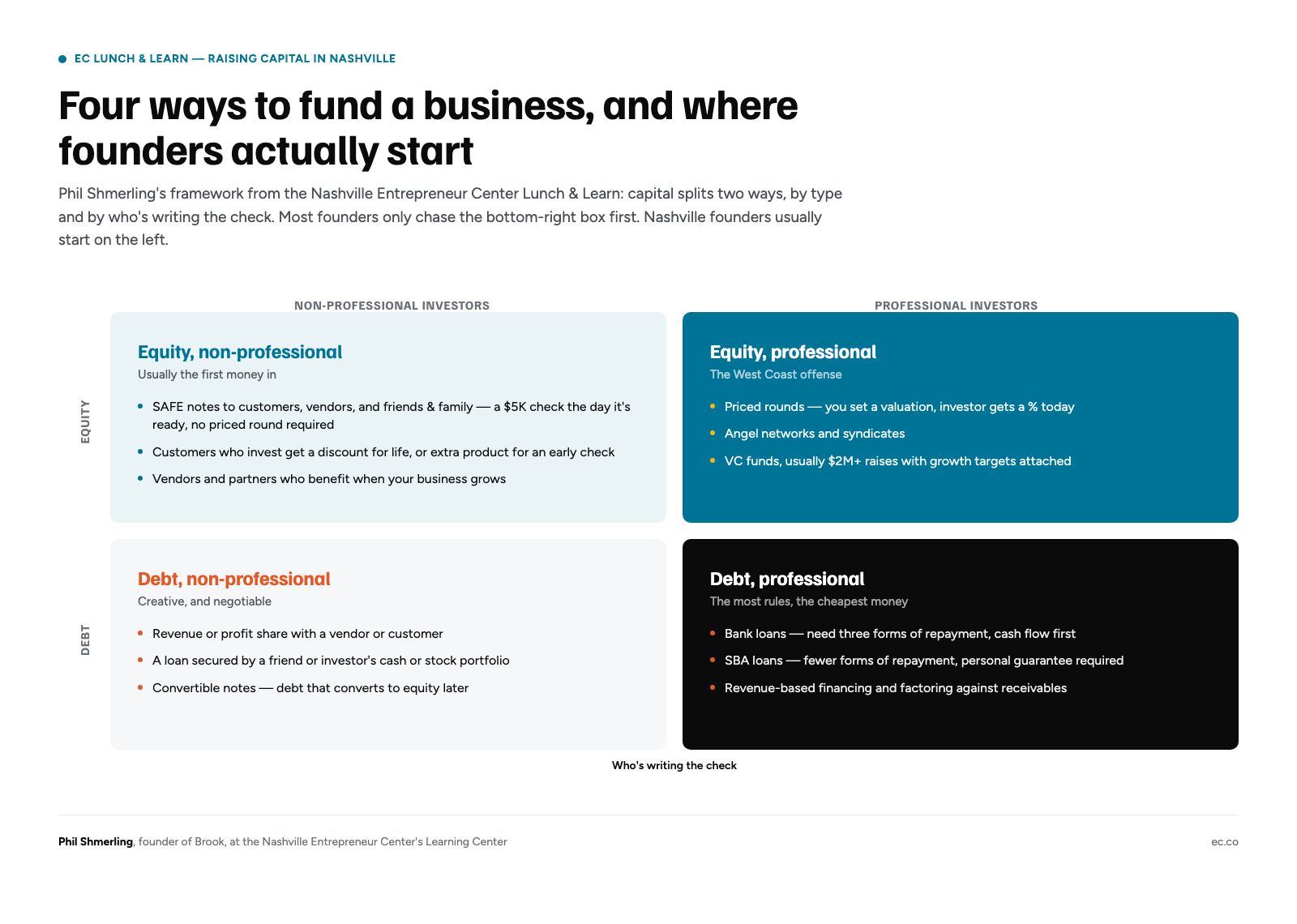
Phil built his framework years ago to train angel investors, and it still works from the founder’s side: four quadrants. Debt or equity. Professional investors or non-professional investors. Most founders only think about one box: equity from professional investors. Phil spent the hour on the other three.
On debt, he broke down what a bank actually needs to say yes (three forms of repayment, cash flow first, always), and where to go when you don’t have that: revenue-based financing, factoring against receivables, a loan backed by someone else’s stock portfolio.
On equity, he explained a SAFE note in plain terms: a way to take a $5,000 check the day someone’s ready to write it, instead of waiting months for a priced round to close with paperwork and a closing date.
“Who benefits from your success?”
The idea Phil kept returning to: non-professional investors aren’t just friends and family. They’re your customers, your vendors, anyone whose business gets bigger when yours does.
His own example: Brook partners with community banks. He doesn’t pitch bank presidents on returns. He pitches them on deposits. “They care about one thing,” he said. “Am I going to bring business into their bank?” His first 13 investors were the people already using his product.
The same logic applies smaller. A restaurant software founder in the room could offer a customer $20,000 worth of software for a $20,000 check today, plus a discount for life. A food distributor with access to a restaurant’s customers might invest just to hand out flyers. None of it requires a term sheet built for venture capital, and none of it is advice you’ll find written down anywhere.
Three founders, three numbers
After Phil, Amy (the EC’s director of engagement) brought up a panel of three EC alumni: Amy Green, founder and CGO of Mamaya Health; Shani Dowell of Possip; and JM Eberhardt, financial risk mitigation strategist at King Legacy Group.
Shani, who also sits on the EC’s board, bootstrapped Possip on her own salary and her husband’s for two years before going full-time in 2018, with $110,000 in revenue that year. She raised her first check from someone in her network, then kept going one conversation at a time. Between 2018 and 2022, Possip raised $6 million.
Amy Green grew Mamaya Health from $386,000 in revenue its first year to $1.8 million the second and $3.2 million the third, all reinvested, no outside capital. When the Change Healthcare breach cut off her insurance reimbursements for four months in 2024, the company survived on cash reserves and a bank relationship she’d built years earlier. Mamaya closed a $3 million Series A last summer.
JM Eberhardt talked about the other side of that same coin: a startup that ran out of money waiting on a deal to close, and a stretch of months so dark he still tells the story as a warning, not a highlight reel. He came out of it running King Legacy Group, a financial risk mitigation firm built specifically so other founders have somewhere to go before they hit the same wall.
The common thread across all three: none of the money that got them through the hardest stretch came from a VC. It came from customers, banks they already had relationships with, and people who’d decided to believe in them early.
The lunch part is real too
This is the pitch the EC doesn’t have to write: a free lunch, an hour with someone who’s actually raised money in this city, and a panel of founders willing to say what raising capital cost them, not just what it got them. Nobody in that room needed a definition of “traction.” They needed to know where their next $20,000 check might come from, and Phil, Amy, Shani, and JM gave them a real answer.
Go to ec.co/events to register for the next EC event.
About the author