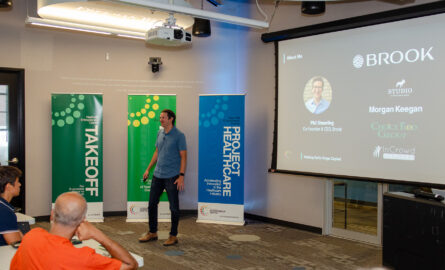
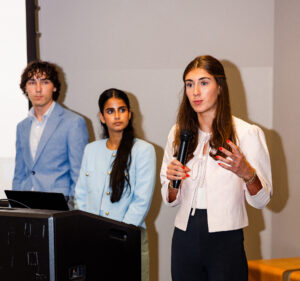
 Five Morehead-Cain Scholars spent eight weeks and 33 interviews mapping how Nashville supports minority and immigrant entrepreneurs. Here’s what they found.
Nashville pulls in more than $11B in tourism every year. Less than 1% of that reaches minority-owned businesses.
That gap sat at the center of a question five University of North Carolina students spent their summer trying to answer: how can Nashville Entrepreneur Center — and Nashville — better support minority and immigrant founders?
The students came to EC through the Morehead-Cain Scholarship at UNC-Chapel Hill. In eight weeks they ran 33 interviews with founders, nonprofit leaders, lenders, city officials, and university staff. Then they presented what they heard.
The finding: it’s not scarcity. It’s connection.
Nashville has the resources. Corner to Corner, Pathway Lending, Conexión Américas, the Black and Hispanic chambers, the city’s own programs, and EC all serve founders right now.
What Nashville doesn’t have is a way to connect founders to them.
Almost every interview returned to the same point. Minority founders don’t know these organizations exist, don’t know when to use them, or fall through the cracks between them. There’s no front door.
The money gap is real — and expensive
The barriers the students documented are concrete, not abstract.
The Urban League put the cost of “making it” in Nashville at more than $80K a year. At one immigrant-serving nonprofit, average bank funding per business fell from roughly $7K to $2K. When traditional capital dries up, founders turn to merchant cash advances — where Tennessee APRs can reach 400%.
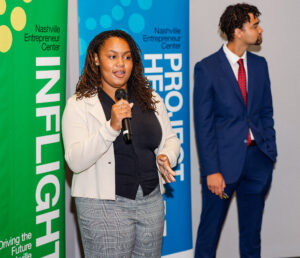
The people most shut out are the ones driving the most activity. Immigrants make up 6% of Tennessee’s population but 16% of new business activity. More than 30% of businesses started in Davidson County are immigrant-owned, and over half are led by women.
Support that stops at graduation
A second pattern showed up again and again: the help that exists often ends when a program does.
Founders finish a cohort, lose their space or their momentum, and have nowhere to go next. One founder saw business drop 70% after losing a location. Programs teach the launch. Few stay for year two.
Six proposals — three for EC, three for Nashville
The students didn’t just diagnose the problem. They proposed fixes.
For EC:
- Summer sprint accelerators — short, technical programs on AI, capital, procurement, and exits during the summer gap, plus founder circles grouped by identity and industry.
- A Community Connector Fund — $25K a year for five trusted local leaders to host monthly events that build founder networks.
- Minority access initiatives — a rebuilt webpage for underrepresented founders, outreach at cultural events, and donor-funded access scholarships.
For Nashville:
- A monthly Entrepreneurship Roundtable to align calendars and route referrals across organizations.
- An online front door — a shared intake site that answers a founder’s ten questions with three matched organizations.
- An inter-university entrepreneurship org connecting student founders across five campuses.
To prove the front door could work, they built one — a working prototype that routes a founder to matched organizations in about a minute.
“The scholars spent time talking to the right organizations, and they used their findings to make recommendations and even a prototype that can make a difference. Now Nashville needs to get to work.”
— Sam Davidson, CEO, Nashville Entrepreneur Center
Why it matters to EC
EC has served more than 14,000 entrepreneurs since it opened. This research is about the ones who haven’t walked in yet.
The founder who never applied because they didn’t know the door was open. The immigrant owner paying 400% on a cash advance because no one connected them to Pathway Lending. Those are the founders these five students spent their summer listening to.
Celebrating the work
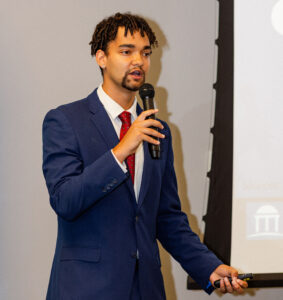 Thank you to Ayushi Purohit, Beau Legnon, Julissa Bell, Justin Jackson, and Sloane Whalen. Eight weeks, 33 interviews, six proposals, and a working tool. That’s a real contribution to Nashville — not a summer project.
The appreciation runs both ways.
“I couldn’t think of a more transformative and engaging experience for a summer.”
— Justin Jackson, Morehead-Cain Scholar
See their full presentation → View the deck
About the author