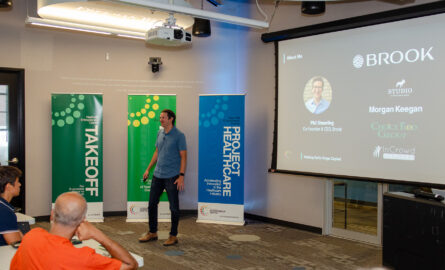

Richard MacKinnon didn’t expect to walk out of The Room as Ian Nott’s next investor. What happens there doesn’t always stay there.
The Room is invitation-only — reserved for Nashville Entrepreneur Center growth partners and McWhorter Circle supporters, people who have committed real resources to Nashville’s startup ecosystem. You don’t wander in. You show up because you’re already invested.
Ian was on stage running a live demonstration of Xuron’s platform. On screen: an AI-virtual human. An antibiotic-resistant UTI. The kind of uncomfortable, high-stakes conversation that most healthcare providers only get better at through experience — which means some patients bear the cost of that learning curve.
Richard was then executive director of Music City PrEP Clinic. After the presentation, he tracked Ian down.
He thought this technology could work in his clinics. He also wanted to invest.
The Problem Worth Building For
Ian Nott grew up in Hillsboro Village. Went to Hillsboro High. Born at what is now Ascension Saint Thomas. When he talks about Nashville, he talks about it the way people talk about a place they watched become something — from the inside.
He founded Xuron around a specific problem: clinicians need to practice difficult conversations, and there’s almost no good infrastructure for it. High-risk addiction discussions. HIV diagnoses. Nuanced scenarios where the wrong word, the wrong tone, the wrong framing can change a patient’s outcome. Xuron built AI-powered virtual humans to help providers get better at exactly those moments — before they encounter them in the exam room.
When it came time to raise capital, Ian wasn’t looking west. He knew what he was building had roots in Nashville, and he wanted the cap table to reflect that.
“It’s those personal relationships, even in this kind of remote world that we live in, that really help close deals,” he says.
His seed round was led by 3LS Ventures, with LaunchTN, and the Music City PrEP Clinic. Over 80% of Xuron’s early funding came from Nashville and Tennessee institutional and strategic investors. Face-to-face meetings. Handshakes. Trust-building that doesn’t compress.
One Room, One Demo
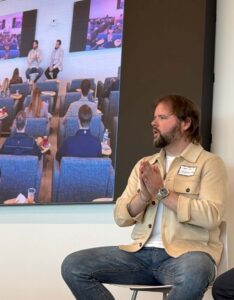
The presentation at The Room wasn’t a calculated move, but a chance for Ian to strengthen his partnership with EC supporters.
Richard MacKinnon was there. He saw the demo. He saw a virtual clinician walking a provider through a real clinical scenario, and something clicked about what this could mean for his clinic networks — PrEP adherence conversations, STD testing protocols, how to relay an HIV diagnosis with the care that moment requires.
“It was that original interaction and exposure via the Entrepreneur Center and presenting at The Room that sparked that initial genesis of those discussions,” Ian says.
A few meetings later, Richard was on the cap table. Later that year, Xuron was deployed into Music City PrEP Clinic.
What Followed
Thousands of Tennessee patients are now being reached through that partnership — downstream of a demo at a Nashville event that almost nobody outside that room ever saw.
The reach doesn’t stop at state lines. In December 2025, Xuron launched its largest deployment yet: an FDA Risk Evaluation and Mitigation Strategy program for opioid risk training — up to 6,000 compleators working through high-stakes simulations on opioid-related harm. In the first couple months since launch, over 1,500 clinicians had already completed the program. Based on preliminary outcomes data from the cohort, based on clinician responses that within a year, more than one million US opioid risk patients will be affected by what those providers learned.
LaunchTN — which invested in the original seed round — voted to reinvest. That’s not automatic. They ran due diligence, reviewed traction, looked at outcomes data across therapeutic areas, and decided the trajectory earned another bet.
“All day, every day, even right now, as we speak across the country, clinicians are earning real continuing medical education credit facilitated through our programs,” Ian says.
What Nashville Gets Right

Ian has watched other founders come to Nashville from the coasts with a certain set of expectations about how early-stage fundraising works. He’s direct about the difference.
“There’s a bit of a balance where you can have that high technology play, you can have that high growth play, but you can do it in a little bit more of a pragmatic fashion,” he says. “On the West Coast, you’re raising tens and tens of millions of dollars and you’re blowing out your cap table and you’re just kind of killing yourself as a founder to potentially kind of lose it all in the end.”
His advice for founders raising locally: don’t show up pre-product, pre-revenue, and expect a check. “Ultimately, to raise capital successfully, you need to have that soup in front of you with all those ingredients stewing.”
Xuron is a Nashville company — not because Ian couldn’t have built it elsewhere, but because he chose to. The ecosystem showed up: introductions, capital, a room full of people who had already decided Nashville was worth betting on.
That’s how it’s supposed to work.
Learn more about Xuron at xuron.io
The Entrepreneur Center is Nashville’s hub for entrepreneurship. Join the McWhorter Circle to get in The Room and support founders ready to scale. ec.co/mcw
About the author