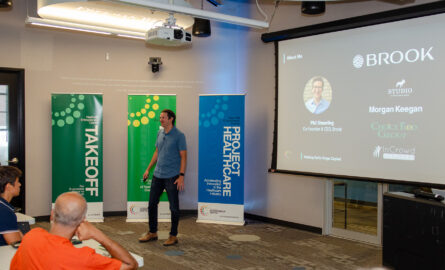
 Last week, a room full of Nashville entrepreneurs got an hour of professional-grade financial strategy for free.
That’s not a promotional line. That’s just what happened.
Chris Brown — EC member and cash flow strategist who has spent a decade working with everyone from pre-revenue startups to nine-figure companies — walked into the EC’s Lunch & Learn series and gave away the frameworks he charges clients for. No pitch. No upsell. Just the stuff founders actually need to know about cash.
The topic: how to allocate capital when you have money, and how to extend your runway when you don’t.
The Flooring Installer Who Didn’t Know What He Was Worth
Chris opened with a client story that landed for most of the room.
Tre runs a flooring installation business in Birmingham. Great reviews. More demand than he could keep up with. His wife logged jobs in spiral paper notebooks. And no matter how many jobs he took, he was always stressed, always broke.
When Chris sat down with him, the notebooks came out. They went through the jobs, the costs, the overhead. What Tre was charging. What Tre needed to charge.
“He just needed to bump up his prices,” Chris said. “But it took us going through this exercise together for him to actually realize that’s what he needed to do.”
Tre had been quoting at market rate without ever accounting for what it actually cost him to live and run the business. His work was worth more than he thought. During COVID, after fixing his pricing, he increased net profits by 94% in 9 months.
Not by adding customers. Not by hiring. By seeing what was already there.
The Framework: Two Questions, One Number
Before strategy, Chris said, every founder needs to know two things: how much cash do you have right now, and what does it cost you every month to exist — rent, payroll, subscriptions, all of it.
Divide one by the other. That’s your runway.
Less than three months? You’re in what he calls runway extension mode — cutting costs, buying time, surviving to the next inflection point. More than three months? You’re ready to think about capital allocation: figuring out what’s already working and putting more behind it.
“Capital allocation is pouring gas on a flame that’s already burning,” he said. “If something isn’t working, more money isn’t going to fix it. You’re just pouring gas on wet wood.”
He also drew a sharp line between a budget and a cash flow model — a distinction that unlocked something for a lot of people in the room.
“A budget is a plan you set and don’t touch. A cash flow model is a GPS. If there’s a wreck 10 miles down the road, it recalculates.”
What Happened When the Numbers Were Finally on the Table
He walked through four more client stories, each one a different version of the same problem: founders making decisions without visibility.
A specialty food distributor doing $3 million a year — profitable on paper, but buried in high-interest debt because cash flow was an afterthought. After building a weekly tracking system, he paid off half a million dollars in bad debt and cut his cash management time from three hours a week to 15 minutes.
An entertainment services company with 10,000 customers a year, charging $20 a head, wanting to expand into new markets. Chris reframed the question: what if you went deeper on what’s already working before going wider? Raising prices and enhancing the existing experience could take them from $20 a head to $250 or more — without the overhead of new markets.
An events coordinator planning the biggest event of their career — a six-figure production with a lot of money on the line. “In his words, he was going blind into this, just wishing, hoping, and praying that it would work out.” Four hours with Chris and a detailed cash flow model gave him what he actually needed: not a guarantee, but enough clarity to move forward and request funding.
What Founders Left With
Chris was clear that this isn’t about becoming a spreadsheet wizard.
“You do not have to be a financial expert to be a successful business owner,” he said. “What most people need is a system that gives them clarity, confidence, and control.”
The goal, he said, is getting back to the part of the business you actually built it for. Cash flow management shouldn’t be front-of-mind. It should be background noise — something that runs quietly while you focus on the work.
“Cash flow management is a weekly exercise,” he said. “It’s like going to the gym.”
If you want to go deeper, Chris published a full companion article on his Substack — every slide from the talk, the complete transcript, all the decision-making frameworks, and the AI prompts he walked through. He calls it the most valuable piece of content he’s written to date, and it’s free.
The Art of Cash Flow: Allocating Capital & Extending Runway → claritycashflow.substack.com
That kind of thinking — practical, earned, grounded in real client outcomes — is what showed up in a free lunchtime session at the EC last week. And it’s what shows up at the Lunch & Learn series regularly.
If you’re building a business in Nashville, this is the room worth being in.
See what’s coming up → ec.co/events
About the author