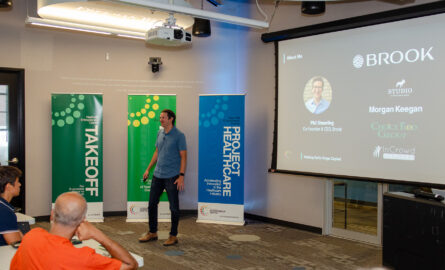
Saurabh Sinha didn’t bring a deck.
He walked into the Nashville Entrepreneur Center on February 27 and sat down with 22 healthcare founders — people building burnout platforms, causal AI for clinical decisions, color-changing infection sensors, and medical device approval software. His only agenda: hear their problems and say something useful.
Saurabh built a healthcare software company from scratch, moved it to Nashville in 2005 when health tech attracted almost no founder interest, and grew it to hundreds of millions in revenue and thousands employees before transitioning to the Chairman role in 2023. He’s seen the industry from every angle. What followed was an hour of direct advice that had a lot of founders’ heads nodding.
Build like you plan to live there.
Someone asked about exit strategy. Saurabh’s answer surprised the room.
“Build like you’re building a house to live in forever,” he said. Don’t make structural decisions based on a six-year hold. Don’t optimize the foundation for someone else’s acquisition criteria. Build something real, something you’d want to run indefinitely, and the exits take care of themselves. His own exit wasn’t the destination — it was a byproduct of building well.
Several founders said afterward this reframed how they were thinking about their companies. That’s the thing about obvious wisdom: it only sounds obvious after someone says it clearly.
Your competition isn’t who you think it is.
This is where most healthcare founders get into trouble. You map your competitors. You build a slide showing why you’re better. You walk into a buyer meeting and discover they’re not comparing you to any of those companies.
“When you go talk to a buyer, you’ll be amazed what their other options are,” Saurabh told the room. Buyers compare you to their existing workflow. To their in-house team. To doing nothing. “Not doing anything is also an option.”
If you don’t know which alternative you’re actually competing against, your pitch is built on a wrong assumption. The fix isn’t a better slide. It’s deeper customer discovery before you build the pitch at all.
You’re talking to the wrong person.
One founder asked about ROI metrics — specifically, how to get hospital systems to care about nurse retention savings when the financial impact is hard to measure short-term.
Saurabh’s diagnosis: you haven’t found the right executive yet. “Whoever is hurting the most is the one to talk to.” A revenue executive three layers removed from the problem will give you metrics that don’t connect to pain. The person you need is the one with scheduling surprises, malpractice exposure, and staff calling in short on a Tuesday night. They’ll tell you exactly what your product is worth — in language a CFO will eventually understand.
Build a bridge, don’t burn theirs.
On selling into enterprises that already have a solution, Saurabh was direct. Don’t walk in assuming they’re doing nothing. They’re not. They have a process, a vendor, a person responsible. “Make sure you’re not ignorant about what they are doing,” he said. Your job is to understand their existing approach well enough to build a bridge from it to yours. That’s how you enter the conversation without threatening the person who made the last decision.
On AI: slow down.
Several founders in the cohort are building AI-native products. Saurabh offered a reality check. Healthcare enterprises are cautious about AI—not because they don’t believe in it, but because unpredictable costs terrify them. They watched cloud migration bills surprise them. Token-based pricing models create the same anxiety. “They don’t want to be surprised if they budget half a million and get a five million dollar bill.” AI adoption in healthcare enterprise will happen. It’s just not moving as fast as the pitch decks suggest.
The market is open. That part is true.
Saurabh closed with something founders needed to hear: the timing is genuinely good. Amazon, CVS buying Aetna, a decade of health tech success stories — large enterprises have seen that outside innovation works. The door that was closed when he started in 2005 is open now. “The timing is good. A lot depends on your product and how you position it.”
Twenty-two founders. One morning. All access. All possibilities.
This is what EC’s Project Healthcare program looks like from the inside.
About the author