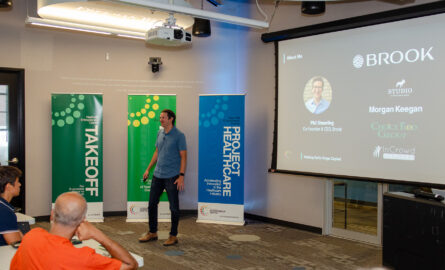
 While you were eating a desk salad, a room full of EC members watched someone casually ask AI to remote into a Raspberry Pi and generate a motion graphics video. Then he dictated—not typed—a command that scraped 1,100 insurance leads in under 90 minutes.
This wasn’t a sales pitch. This was Luke showing actual work he does every day.
What Actually Happened
Luke Thompson, co-founder of The Operations Guide, opened his laptop and demonstrated what most people think is impossible: an AI workspace that connects every tool he uses—Gmail, Google Drive, Slack, Trello, project management platforms—into one interface where he can dictate commands and watch sub-agents execute complex tasks in parallel.
The specifics matter:
- He helped an attendee research competitive leads for a behavioral health startup called Mindwise Health—live, during the presentation
- His AI assistant triages his email each morning, categorizing what needs action versus what teammates are handling
- He migrated an entire project management system from one platform to another by asking Claude to handle it
- He reduced newsletter production time by 74% (5 hours to 77 minutes)
- His average dictation speed: 118 words per minute versus the human typing average of 40
The Part That Should Scare You
MIT studied $40 billion in enterprise AI spending. 95% saw zero return.
Why? Because organizations bought technology without identifying the actual problem.
Luke’s approach inverts this: start with the problem (we need qualified leads, our onboarding loses 30% of members in the first month, donor renewal rates are declining), then ask if AI solves it.
Sometimes it does. Sometimes you just need better project management.
What This Means for EC Members
The knowledge gap isn’t technical anymore. Luke isn’t a software engineer. He’s technical enough to be dangerous, and he uses dictation software (Wispr Flow) because typing is so typewriter.
The gap is conceptual: understanding what’s actually possible versus what vendors promise.
Here’s what members learned:
Model Context Protocol (MCP) is the 80% solution. It means your AI can connect to actual tools you use—not just chat with you about work, but execute work across Gmail, Slack, HubSpot, Google Sheets simultaneously.
Agent workflows run in the background. Luke has 50-100 sub-agents running at any moment doing lead research, content creation, CRM migrations while he’s doing something else entirely.
Voice dictation eliminated typing as a bottleneck. He’s dictated 345,000 words in three months.
Claude for Chrome can navigate websites, fill forms, scrape data, and compile it into spreadsheets without human intervention.
The Brutal Truth
One attendee asked: “Are we all out of work in five years?”
Luke’s answer: There’s more opportunity now than ever before, but only for people who adapt.
He’s right. The businesses that treat AI like a magic solution will join the 95% with nothing to show. The ones that identify specific operational problems—then deploy AI strategically—will operate at speeds their competitors can’t match.
What You Should Do
The EC brings practitioners like Luke to events regularly. People who showing how they actually work.
This matters because the knowledge gap compounds daily. What Luke demonstrated yesterday will be standard practice in 18 months. The organizations learning it now have 18 months of operational advantage.
If you weren’t in the room, you can’t get that time back (unless you are a member of the EC then you can watch the video of the session). But you can show up next time.
The next lunch and learn won’t wait for you to figure out if AI is relevant to your business. Neither will your competition.
Upcoming EC Events (because learning compounds)
- Fall program recruitment deadline: [date]
- Next expert session: [topic/speaker if known]
- Office hours for members: Every Tuesday, because generic advice is worthless
Not a member yet? The difference between knowing this exists and actually implementing it is access to the people doing it. That’s what membership buys you.
About the author